
Pinhole Designer, software to help build your pinhole camera
Building a pinhole camera is always enjoyable if you like a bit of DIY. There are countless ways to do it using different materials: tin cans, wooden boxes and 3D printing all work well.
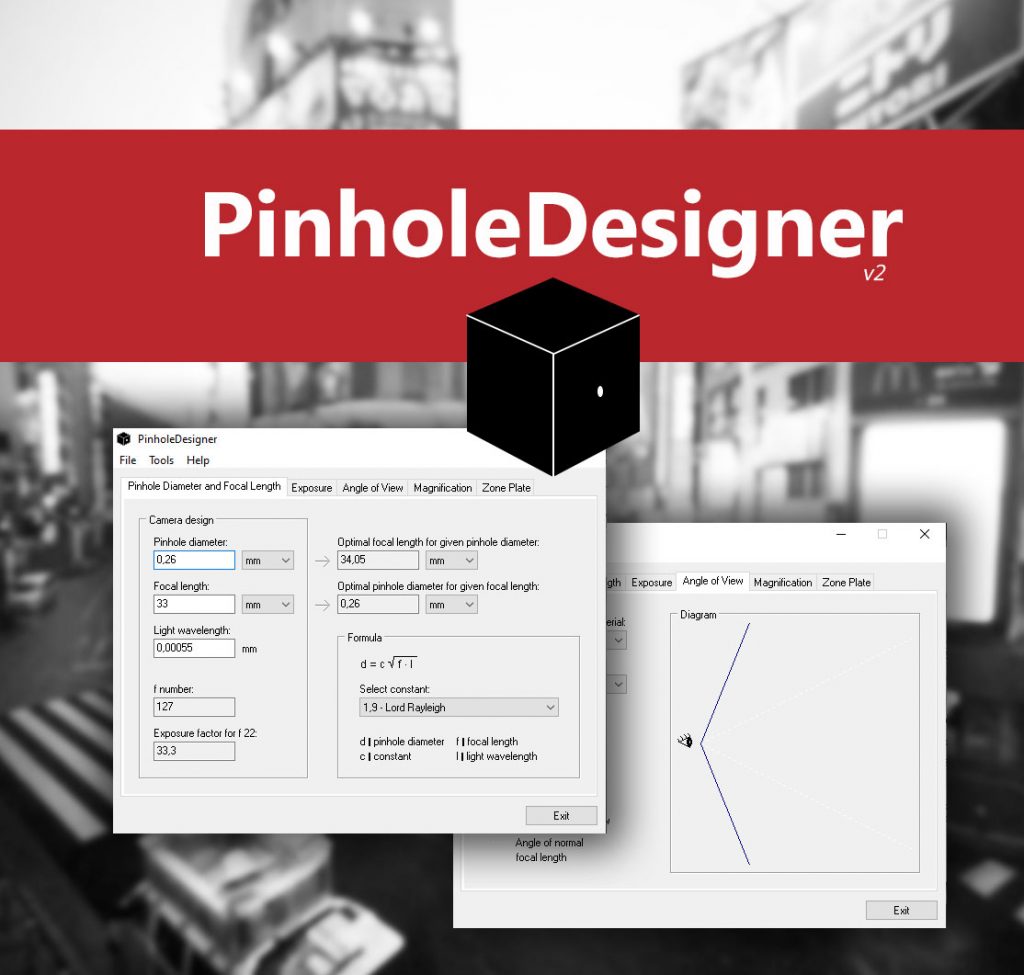
- Free software created by David Balihar (david.balihar@pinhole.cz)
- A toolkit for building a pinhole camera
- Download it here for free
Building a pinhole camera is always enjoyable if you like a bit of DIY. There are countless ways to do it using different materials: tin cans, wooden boxes and 3D printing all work well.
Although the physical construction can be quick and simple, a few parameters must be considered to get the best results from your photographs.
The required hole diameter can be calculated using mathematical formulas that are easy to find online.
But there is also a small, easy-to-use program that provides all this information in a few clicks. I used it to design my pinhole cameras. Here are its different capabilities.

Installation
Download the software from its creator David Balihar’s website: https://www.pinhole.cz/en/pinholedesigner/. It installs like other software.
It was designed for Windows; the original article describes installing it on a Mac using WineBottler.
Among other things, the program calculates:
– the optimal pinhole diameter
– the optimal focal length
– the f-number for a given pinhole diameter and focal length
– exposure times for a given pinhole-camera f-number
– the angle of view, with a diagram

Calculating the angle of view

Calculating the optimal pinhole diameter
Enter the focal length, and the selected formula gives a result: 0.25 mm in my case.
Entering 0.25 mm in the pinhole-diameter field completes the calculation and gives the aperture value: f/128 in my case.